


 Beijing + Tibet Tours
 Chengdu + Tibet Tours
 Shanghai + Tibet Tours
 Xining + Tibet Tours


Lhasa Altitude - How High is Lhasa & Tips to Avoid Altitude Sickness
Latest Tibet Travel News (updated in March, 2026):
⑴. Free admission to scenic spots, as well as discounted prices for transportation and accommodation, have reverted to normal rates. It is advisable to make early reservations to secure the best prices.
⑵. Peach Blossoms in Bomi County, Nyingchi enter the best blooming period. The best blooming period is from March 17 to April 7. Scenic spots in Bomi County and Basum Tso will present a magnificent sight of peach blossoms, and tourists can go there to enjoy the view.
Lhasa, one of the world's highest cities and a popular tourist hotspot, attracts countless travelers. Arriving here, visitors may experience symptoms of high altitude sickness, such as headaches, and shortness of breath, as they acclimatize to the lower oxygen levels. To ensure you're well-prepared, able to effectively prevent and acclimatize to altitude sickness, thus enjoying a better Tibet Lhasa tour in 2026, it's highly suggested to familiarize yourself with this Lhasa Altitude Guide. It provides detailed information on Lhasa city altitude, altitude of Lhasa attractions, practical Lhasa altitude tips, and altitude of Lhasa nearby attractions.
Lhasa City Altitude Overview
Lhasa, the holy city of Tibetan Buddhism and the political, economic, cultural and religious center of Tibet, is located in the middle of the Qinghai-Tibet Plateau, north of the Himalaya Mountains. It is one of the highest cities in the world at an average altitude of 3,650m (11,975ft). Due to its high elevation, Lhasa's oxygen content is approximately 65% of that at sea level.
Altitude of Lhasa Attractions
Most of Lhasa's major attracions, including Potala Palace, Jokhang Temple, Barkhor Street, Norbulingka, Sera Monastery and Drepung Monastery cluster in the city's south-central Lhasa River valley plain. They share relatively similar base altitude, with variations attributed to differences in the height of the structures themselves.
1. Potala Palace (3,700 meters)
Known as the landmark and symbol of Tibet, Potala Palace is the biggest, the best preserved ancient palace in Tibet, also the highest palace in the world. It is a UNESCO-listed World Cultural Heritage and a national 5A scenic spot, covering an area of 360,000 square meters. Situated on Marpori Mountain (the “Red Hill”) of Lhasa Valley, Potala Palace stands at an elevation of 3,700m ( 12,139 ft) and its main structure rising 115.7 meters high. To explore its ancient halls and sacred chambers, visitors must climb a series of stone steps—the actual altitude will increase as they ascend. To make the most of your visit, plan to explore the Potala Palace on your second or third day in Lhasa—giving your body ample time to acclimatize to the high altitude.
Check more about Potala Palace Altitude
 Beautiful Potala Palace

2. Barkhor Street, Jokhang Temple (3,650 meters)
Jokhang Temple, at an elevation of about 3,650m (11,975ft) above sea level, is a Tibetan Buddhism monastery with over 1,300 years of history. Regarded as Tibet'a most sacred and important temple, it attracts devout pilgrims who kowtow reverently outside its gates throughout the day. Surrounded it is the vibrant Barkhor Street, one of Tibet's most famous circumambulation routes and the spiritual heart of Lhasa. As a centuries-old pilgrimage path, it sees devout pilgrims from across the plateau spining prayer wheels and chanting mantras every day. This street itself is also a large living area of old blocks in the central Lhasa, suffused with over 120 handicraft shops, 200 stalls selling various Tibetan-style goods.
 Sacred Jokhang Temple at Barkhor Street Center
5. Drepung Monastery (3,800 meters)
Drepung Monastery, together with Sera Monastery and Ganden Monastery is one of three great temples of Lhasa and the largest monastery in Tibet. It sits at an altitude of 3,800m (12,467ft), at the foot of Gambo Utse mountain, about 10km south of Lhasa downtown. Built along the hillside, Drepung Monastery is surrounded by high mountains on three sides, with a sloping land in the south covered by trees and shrubs. From afar, its clustered white buildings cascade down the hillside like a massive mound of rice—aptly reflecting its Tibetan name "Drepung," which translates to "heap of rice." Tourists arriving in Lhasa by train can catch the sight from Lhasa Railway Station.
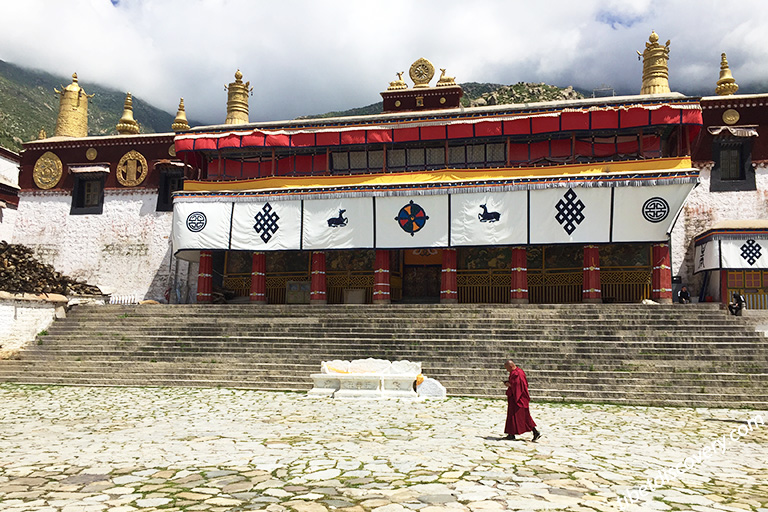 Central Hub of Drepung Monastery
6. Sera Monastery (3,700 meters)
Sera Monastery is one of the three greatest monasteries in Tibet, together with Drepung Monastery and Ganden Monastery. It's a representative temple of Gulug sect, a prime faction of Tibetan Buddhism. Perched on the Serawoze Mountain, Sera Monastery has an altitude of 3,700m (12,139ft). The most notable feature of the monastery is its unique Tibetan Buddhism Scripture Debating, which takes place daily during 15:00 to 17:00. Monks in traditional maroon robes gather in the courtyard, some gesture emphatically with hands clapped or raised, while the other responds thoughtfully. This spectacular practice is both a dynamic way to discuss Buddhist knowledge and a time-honored method of mutual learning for monks.
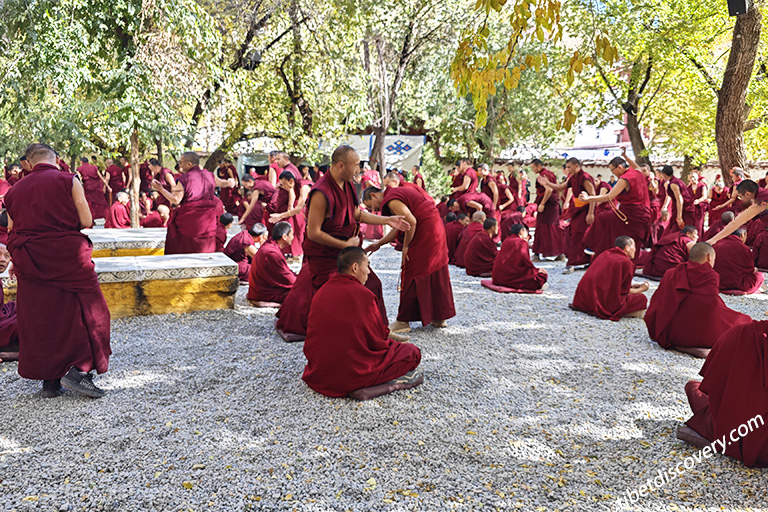 Intense Tibetan Buddhist Scriptures Debate
7. Norbulingka (3,650 meters)
Norbulingka Park is the largest and the most beautiful man-made garden in Tibet. It stands at an elevation of about 3,650m (11,975ft) above sea level. Covering an area of 360,000 square meters with more than one hundred species of plants, Norbulingka Palace is considered to be a highland botanic garden, dubbed "Plateau Oxygen Bar". Near the Potala Palce, it used to be a summer residence and administrative site. In 2001, the park was added to a World Heritage Site, as an integral part of the Potala Palace Historic Ensemble. Each year, during the Shoton Festival, Norbulingka transforms into a bustling hub of activity in Lhasa, where monks unfurl massive thangka paintings, traditional Tibetan opera performances take center stage, etc.
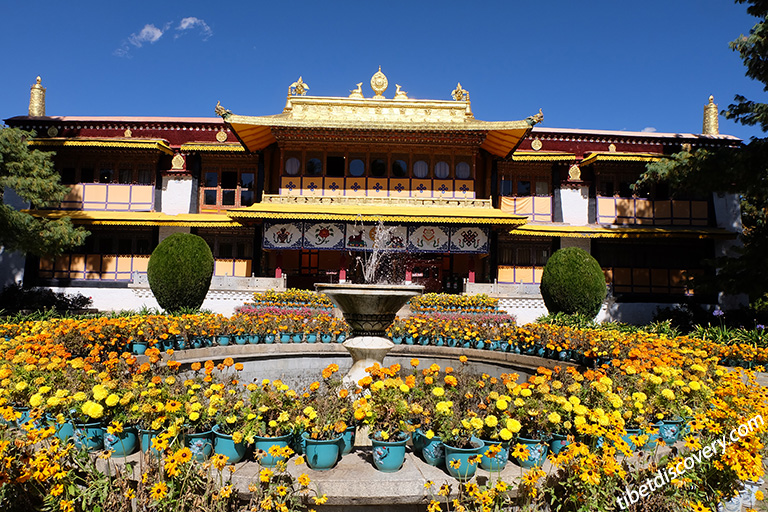 Tibet's Biggest Classic Garden - Norbulingka
8. Ganden Monastery (3,800 meters)
Ganden Monastery is one of the three greatest temples in Lhasa, and the ancestral temple of Gelug sect. Located on Wangbori Mountain along the south coast of Lhasa River in Dagzê County, northeast of Lhasa, the temple sits at an altitude of 3,800m (12,467ft). It was founded during the Ming Dynasty in the 15th century by the founder of Gelug sect, Tsongkhapa. With an orderly architectural layout of Buddha halls, towering roofs, magnificent stupas, Ganden Monastery is constructed with vivid colors of black windows, white, golden, or red walls, like a colossal castle inlaid on the peak. It is also renowned as the iconic starting point of Tibet's classic Ganden to Samye Trek, a beloved route cherished by trekkers and pilgrims.
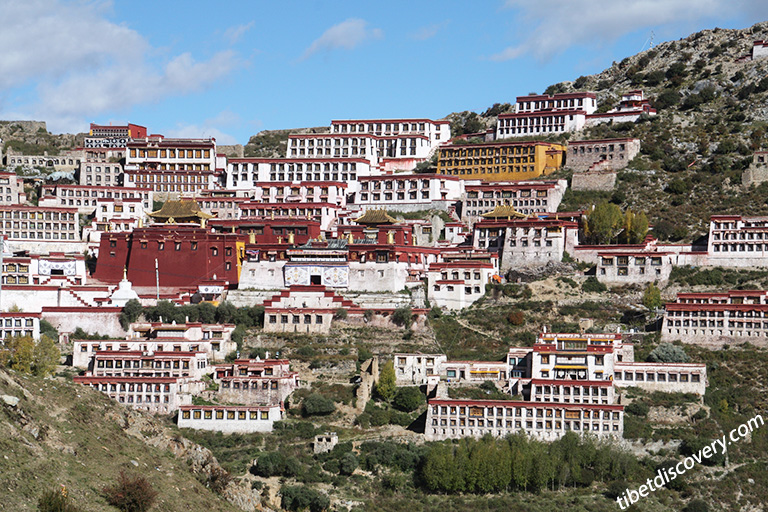 Ganden Monastery Panorama
Lhasa Altitude Sickness Tips
Lhasa Tibet is awed to most people for its high elevation and thin air condition on Qinghai Tibet Plateau. Being a world-class famous destination, Lhasa has received more than 43 million tourists last year, including over 120,000 foreign travelers. Actually, high altitude reaction is related to many factors, such as the elevation, inhabit time, speed of altitude change and personal physique. To help every tourist go on the Tibet tour smoothly, we offer some advices on High Altitude Sickness for your consideration.
Before You Go
1. Undergo a full physical examination 1 to 2 weeks before you enter Tibet. Especially check your cardiopulmonary function and blood pressure carefully. Avoid traveling if diagnosed with hypertension, heart disease, asthma, or acute respiratory infections (e.g., colds).
2. Start taking altitude sickness prevention medicines like Rhodiola rosea 1 to 2 days in advance as advised by a doctor, and pack some with you.
3. Maintain physical fitness in the weeks prior, but avoid intense workouts 3 days before travel to reduce oxygen consumption.
During The Travel
1. You’d better not to take a shower in the first two days after your arrival.
2. Don’t do strenuous exercises, including running, fast walking, etc.
3. Have a high carbohydrate diet every day in the tour. Avoid greasy, spicy food and overeating.
4. Drink 2-3 liters of water daily. Abstain from from alcohol, smoking, and caffeinated drinks during the first 3 days.
5. Not to take sedative hypnotics.
6. Do some relaxing walking slowly to adapt the new environment.
7. Keep warm from getting cold.
If you have severe high altitude reaction, you have to contact the local Tibet guide as early as possible to receive medical treatment in local Tibet hispitals. You can contact us get more helpful advice. Our Tibet tour packages cover all essentials, from tailor-made itinerary, attraction tickets, transfer service, accommodation, meals, etc. Contact us now >>
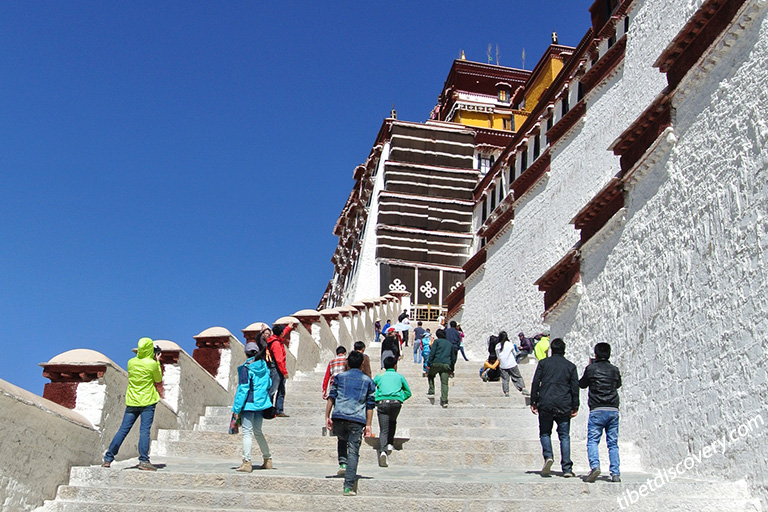 Altitude Ascent at the Potala Palace
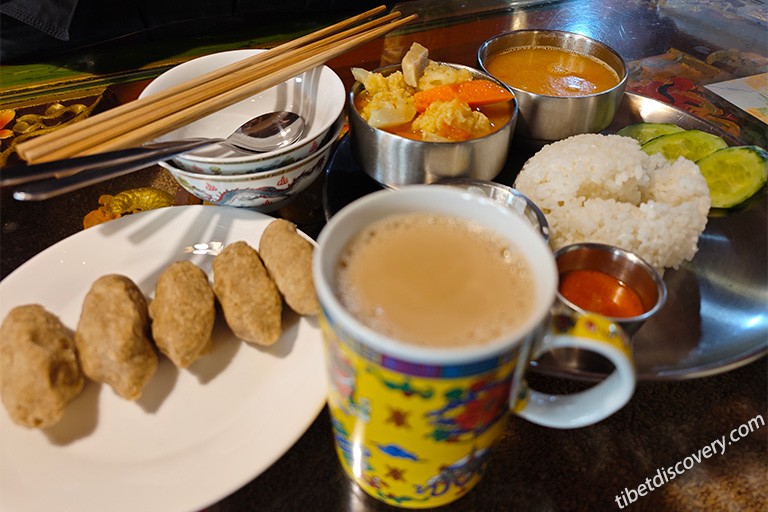 Enjoy High Carbohydrate Food

Altitude of Lhasa Nearby Attractions
Information on the altitude of Lhasa's surrounding attractions and destinations is just as vital, as it directly influences your journey's health, physical adaptation to the plateau, and trip arrangements. Among these major attractions, Namtso Lake, a must-visit for visitors to Lhasa, surpasses in elevation that of most other top destinations in Tibet. Nyingchi has the lowest altitude among all the major destinations in Tibet, and that's why it's regarded as the gateway to the region, while other places like Shannan City, Shigatse City, Gyantse Town, Yamdrok Lake have higher elvations than Lhasa City, not to mention Mount Everest, the highest mountain in the world.
Namsto Lake (4,718 meters) - Must-Visit Attraction near Lhasa
Namtso Lake, about 240km (4 hours by car) to south Lhasa city, is one of the three holiest lakes in Tibet (together with Yamdrok Lake and Lake Manasarovar). Located on Qinghai-Tibet Plateau, at the northwest border of Lhasa and Nagchu prefecture, Namtso Lake is the world's highest large lake with a lake surface elevation of 4,718m (15,479ft). The iconic Nagenla Pass, standing at 5190 meters, overlooks the lake. To the north lies a plateau hilly region with an average altitude of 5000-5500 meters with a gently sloping terrain. To the south and east, the valleys of Gangdisê Mountains (冈底斯山) and Nyenchen Tanglha Mountains(念青唐古拉山脉) stretch, with elevations ranging from 4000 to 4300 meters, rising gradually from south to north.
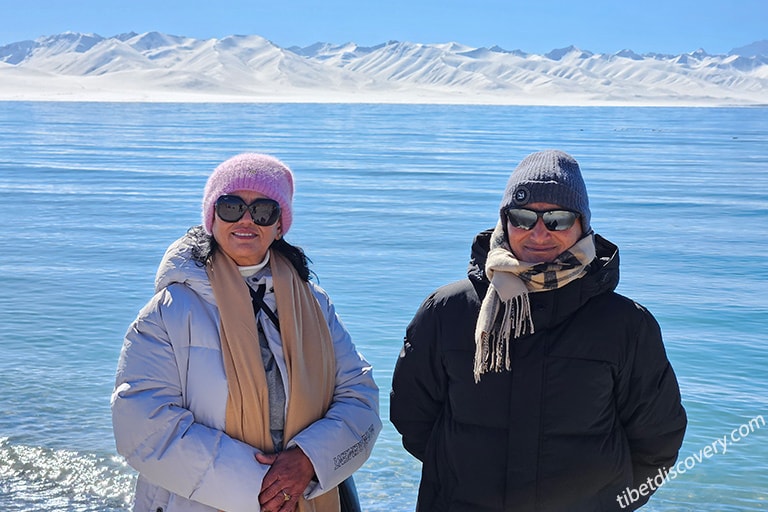 The Pure Blue Holy Lake - Namtso
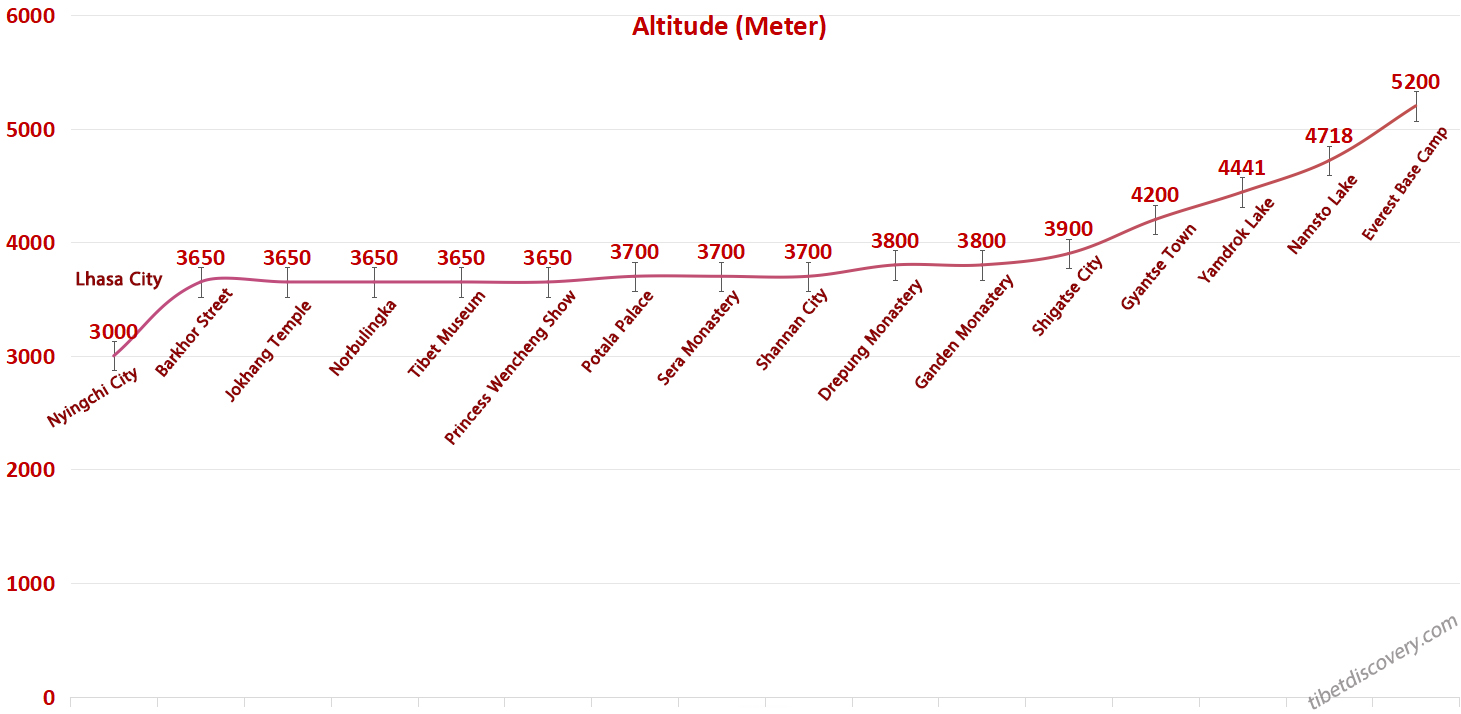 Altitude of Lhasa Nearby Attractions
How to Plan A Tibet Tour
Tibet is too vast to be visited in one single trip, but planning ahead of time can make most of your holiday. A classic Tibet tour always takes about 4 ~ 8 days. Apart from 2 days for arrival and departure, it usually needs 2 other days to explore majestic Potala Palace and other landmarks in Lhasa, the capital of Tibet. With a day trip’s distance from Lhasa, Namtso Lake is another perfect tour extension if you visit Tibet from May to October.
☛ 4 Days Holy City Lhasa Private Tour - Heart of Tibet
☛ 5 Days Lhasa City and Holy Lake Namtso Tour
To explore further, it’s strongly recommended to travel from Lhasa to Mount Everest via Gyantse and Shigatse, which usually needs 4 more days. It is an unforgettable sightseeing trip with lots of attractions to visit, such as Yamdrok Lake, Karola Glacier, Kumbum Stupa of Palcho Monastery, Tashilhunpo Monastery, etc. Of course, the biggest draw must be gazing upon the unparalleled north face of the world’s highest peak – Mount Everest.
☛ 6 Days Lhasa Gyantse Shigatse Historical Tour
☛ 8 Days Everest Base Camp Tour - Top of the World
☛ 9 Days Tibet Discovery Tour plus Everest and Namtso Expedition
For Buddhist followers and hiking lovers, you are suggested to travel to Ngari to join the kora around the holy Mt. Kailash and sacred Lake Manasarovar, which usually takes about 5 ~ 8 more days from Lhasa. The wild nature of Ngari is spectacular as well.
☛ 13 Days Mt. Kailash & Lake Manasarovar Trekking Tour
☛ 16 Days Mt.Kailash Pilgrimage Private Tour
Most travelers combine a Tibet trip with visits to other top destinations, often extending their journey from nearby hubs like Chengdu, Xian, Yunnan, or Xining, or pairing it with iconic cities and landscapes such as Beijing, Shanghai, Zhangjiajie, Guilin, etc. If you have your own needs or interest, just feel free to contact us to customize a trip of your own!
 Lhasa, Namtso, Mount Everest and Ngari are four most popular destinations in Tibet
Recommended Tibet Tour Packages
Tibet has too much to offer. And our aim is to bring you the best experience in Tibet. Following are some other recommended Tibet tour packages that you may be interested in. All of our Tibet tour packages are customizable to meet your personal requirements. You can also contact us to customize a trip if you want.
-

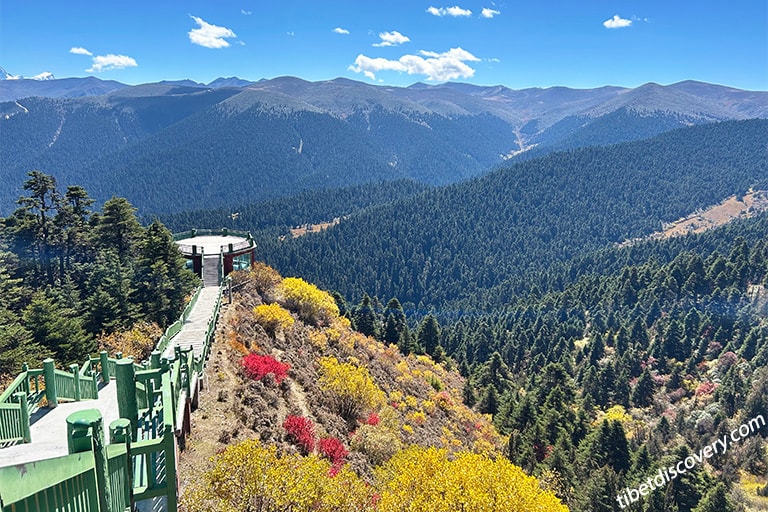
Lhasa / Yamdrok Lake / Gyantse / Shigatse / Mount Everest / Lhasa
8 Days Lhasa to Mount Everest Private Tour with Base Camp Experience
Highlights: Potala Palace, Jokhang Temple, Yamdrok Lake, Palcho Monastery, Everest Base Camp, Sakya Monastery, Tashilhunpo Monastery
-
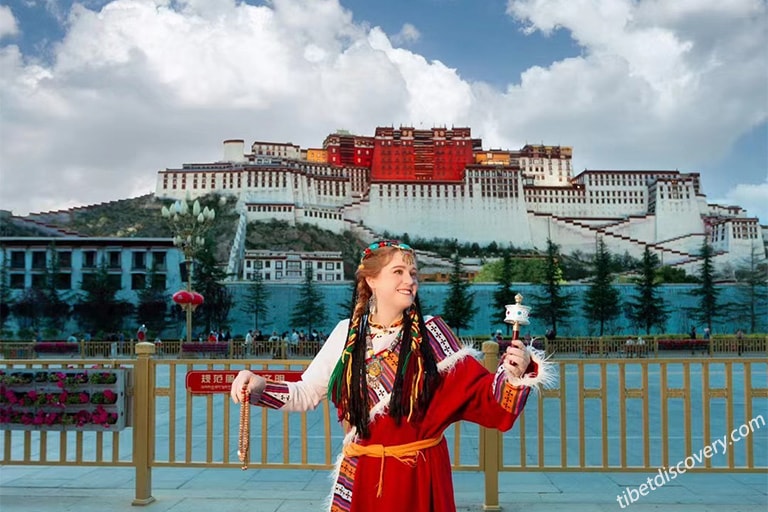
Lhasa
4 Days Holy Lhasa City Highlights Private Tour with Cultural Heritage Treasure
Highlights: Potala Palace, Jokhang Temple, Barkhor Street, Norbulingka, Sera Monastery Monk Debate
-
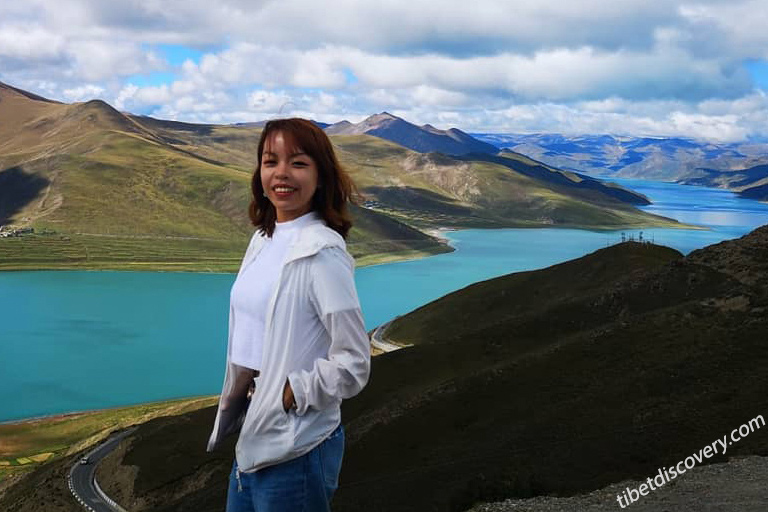
Lhasa / Gyantse / Shigatse / Mount Everest / Gyirong
7 Days Lhasa to Gyirong Border Overland Tour via Mount Everest
Highlights: Potala Palace, Yamdrok Lake, Palcho Monastery, Mount Everest
Lhasa Travel Guide
Lhasa Transportation
Prefer to tailor a trip that totally suits your requirements and interests? Our 20+ professional, helpful and friendly travel experts are ready to help! Tell us your needs, and one of our experts will get to you with trip details within 0.5~23.5 hrs. You can also call us at 86-28-85227275 / 86-28-85223672.

 Karen
Karen Wonder
 Jack
Jack Rita
Rita Johnson
 Vivien
 Wing
Wing Ariel
Ariel Leo
Leo Tracy
Tracy Evelyn
 April
April Phoebe
 Kelly
Kelly Shirley
 Reya
Reya Elk
Elk Samantha
 Bliss
Bliss York
York Felix
Felix Sean
SeanOur specialists are always ready to help!
Have a question? Get answers from our travel experts soon!
- Your Question:
- Your Name:
- Your Email:
- Submit